
Historical Peach Jelly Recipe
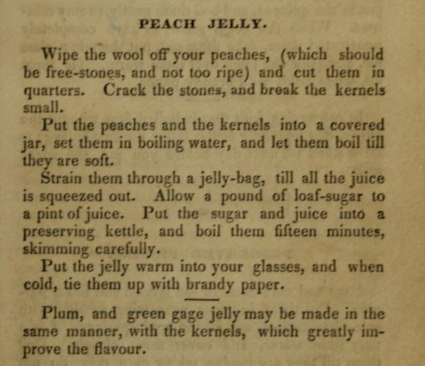
This recipe comes from the 1828 book Seventy-five receipts for pastry, cakes, and sweetmeats by Eliza Leslie under the penname "Lady of Philadelphia."
Unlike modern peach jelly recipes, Eliza Leslie offers a traditional way to make this sweet treat without store-bought pectin and with only two ingredients: sugar and peaches. The steps are fairly simple but could be a bit more difficult to execute if not prepared properly. The recipe:
Wipe the wool off your peaches, (which should be free-stones and not too ripe) and cut them in quarters, Crack the stones, and break the kernels small. Put the peaches and the kernels into a covered jar, set them in boiling water, and let them boil till they are soft.
Strain them through a jelly-bag, till all the juice is squeezed out. Allow a pound of loaf-sugar to a pint of juice. Put the sugar and juice into a preserving kettle, and boil them twenty minutes, skimming carefully. Put the jelly warm into your glasses, and when cold, tie them up with brandy paper.
There are a few things to note with regards to kitchen safety. First when boiling the peaches in a covered jar, make sure that the jars you use are heat safe and air-tight. Mason jars designed for food preservation are typically good for boiling water canning while store-bought re-used glass jars and bail jars might not be able to keep their seal or break under hot temperatures. In the pot where you are boiling the peaches, you may also want to leave a cloth or heat-safe towel at the bottom of the pan so that your jar does not come in contact with the bottom.
Regarding the peach kernels, the recipe asks for the kernels to be broken small and added to the jars when boiled. This is because the pits and kernels of stone fruit (like peaches and apricots) contain pectin which is what helps the jelly get its specific texture when cooked. However, according to the Poison Control, peach kernels do contain amygdalin which is substance that can turn to cyanide when digested by enzymes in the gut. Because of this, it is generally advised that when making peach jelly you do not break the kernels into small pieces, but instead leave the pits whole. A single peach pit is not likely to contain enough of this chemical to cause serious harm to most people, although it is good to err on the side of caution.
Peach Jelly
Ingredients:
- Peaches (not too ripe)
- Sugar
Directions:
Wipe the wool off your peaches and cut them in quarters. Leave the pits whole.
Put the peaches and the pits into a covered jar, set them in boiling water, and let them boil till they are soft. This should take about ~20-30 minutes depending on how large your jars are.
Strain the peaches from the jars through a jelly-bag, till all the juice is squeezed out.
For every pint of juice add about a pound of sugar. This ratio may look different if your peaches are already very sweet.
Put the sugar and juice into a preserving kettle, and boil them twenty minutes, skimming carefully.
Put the jelly warm into your glasses, and when cold, tie them up with brandy paper.
One way to enjoy the jelly is to spread on bread with salted butter. The saltiness and creaminess of the butter works very well with the sweetness of the jelly!
Sources:
Eliza Leslie, Seventy-Five Receipts, Boston: Munroe and Francis, 1828
Holzbecher MD, Moss MA, Ellenberger HA. The cyanide content of laetrile preparations, apricot, peach and apple seeds. J Toxicol Clin Toxicol. 1984;22(4):341-7. doi: 10.3109/15563658408992565. PMID: 6098693.
Joshua Drobina, B. (n.d.). Are peach pits poisonous?. Poison Control. https://www.poison.org/articles/are-peach-pits-poisonous-224