
Historical Ketchup Recipe
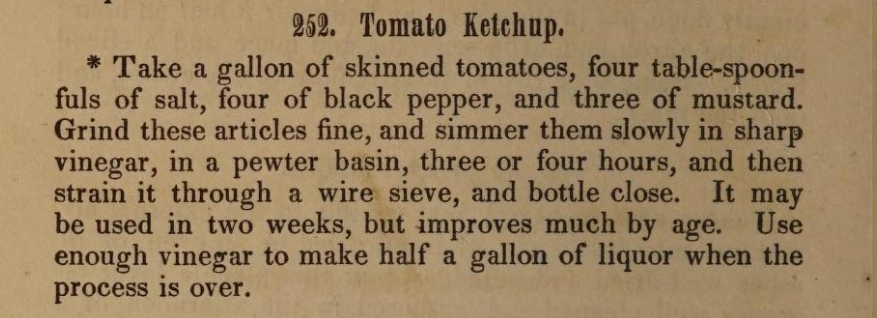
This historical recipe for ketchup comes from the 1847 book The New England economical housekeeper and family receipt book by Esther Allen Howland. The recipe is as follows:
Take a gallon of skinned tomatoes, four table-spoonfuls of salt, four of black pepper, and three of mustard. Grind these articles fine, and simmer them slowly in sharp vinegar, in a pewter basin, three or four hours, and then strain it through a wire sieve, and bottle close. It may be used in two weeks, and improved much by age. Use enough vinegar to make half a gallon of liquor when the process is over.
History:
Unlike what you would most likely find in modern ketchup, this historical recipe does not include sugar.
Eliza Smith’s The Compleat Housewife from 1727 contains the first English published recipe for ketchup: a thin mixture of vinegar, white wine, anchovies, shallots, lemon peel, horseradish, and a passel of spices. This mixture does not include tomatoes and is more savory than the sweet-tangy mixture we know of today. In fact, the first published tomato-based ketchup recipe would only get published in 1812 and it would not include vinegar, unlike most modern recipes.
In Pure Ketchup, Andrew F. Smith notes that sugar was actually not a common tomato ketchup ingredient until after the Civil War: “The addition of sugar into tomato ketchup was a reflection of a trend favoring sweetness in American cookery... As sugar prices rapidly decreased due to the manifold increase in importation from the Caribbean, its use expanded in many dishes.”
Tips, substitutions, and recipe changes:
The first step in the recipe is to take a gallon of tomatoes skinned. If you do not have the resources or time to skin and crush tomatoes, canned crushed tomatoes may also work. To easily skin your tomatoes, wash the tomatoes and make "x" marks on the bottom side with a sharp knife. Blanche the tomatoes for about 60 seconds and submerge in a cold ice-bath. After they cool down the skins should easily peel off with a paring knife or with your hand.
For your spices, our historical recipe is fairly simple, keeping it down to three spices: salt, black pepper, and mustard seed. Whilst not entirely historically accurate as dehydration of some of these ingredients did not become mass produced until the mid 20th century, if you would like a more familiar ketchup taste you can also add a little bit of onion powder, garlic powder, celery seed, allspice, cloves, and cayenne.
The historical recipe is also a bit vague about how much vinegar to add to our gallon of tomatoes. A good ratio of tomatoes to vinegar is generally between 2:1 or 4:1. For example, for 4 cups of tomatoes one can use about 1 cup of vinegar. In addition, if you do want to add sugar to balance out the acidity of the tomatoes and vinegar, a good ratio of tomatoes to sugar is about 8:1 (for 4 cups of tomato, use 1/2 cup of sugar or less). For a simple ketchup taste you can add granulated sugar, for a more barbeque sauce taste you can add brown sugar, and for a sugar-free alternative you may ever use maple syrup though the taste of your ketchup is going to change drastically.
Lastly, the amount of time it takes to simmer the ketchup is going to change depending on your stove and how many tomatoes you actually used. For 4 cups of tomatoes, simmering for 100 minutes is generally sufficient. You can use a slow cooker as well. If you end up cooking your tomatoes for too long, you will be left with a paste more than a sauce although this can be easily fixed by adding a bit of water to create a more runny texture.
Tomato Ketchup
Ingredients:
- Tomatoes
- Mustard
- Black Pepper
- Salt
Directions:
- For a gallon of skinned tomatoes add four table-spoonfuls of salt, four of black pepper, and three of mustard. Crush your tomatoes and grind your spices.
- For 1 gallon of tomatoes, add 1/4 to 1/2 gallon of vinegar. Simmer in a pewter basin, three or four hours.
- Strain it through a wire sieve, and bottle close. It may be used in two weeks, and improved much by age.
Sources:
Mrs. E. A. Howland, The American Economical Housekeeper, and Family Receipt Book, Worcester, MA: William Allen, 1845
Zuras, M. (2023, June 30). The surprisingly fishy history of America’s favorite condiment. Epicurious. https://www.epicurious.com/ingredients/history-of-ketchup